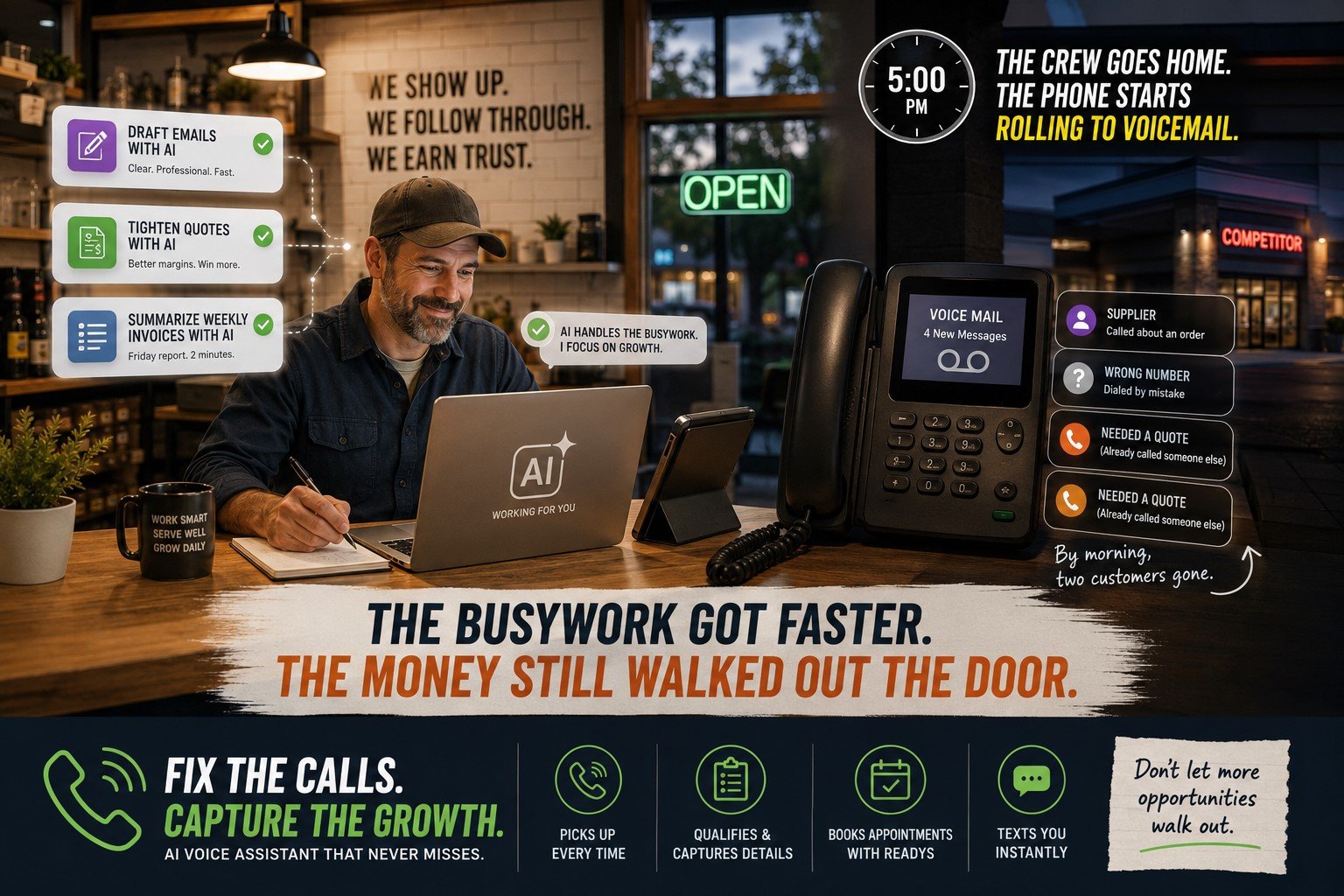
Picture a shop that has actually done the work on AI. The owner drafts emails with it, tightens up quotes with it, has it summarize the week's invoices every Friday. By any honest measure, they are ahead of most small businesses.
Then five o'clock hits, the crew goes home, and the phone starts rolling to voicemail.
The next morning there are four messages waiting. One is a supplier. One is a wrong number. The other two wanted a quote, and by the time anyone calls back, both have already found someone else. The busywork got faster all week. The money still walked out the door.
Most of us automated the wrong end of the day
Small businesses are further along with AI than they were a year ago. Intuit's 2026 AI Impact Report, built with economists at the University of Chicago on more than 34,000 survey responses and anonymized data from over five million businesses, found regular AI use jumped from 48 percent in the middle of 2024 to 77 percent by January. Most of those users, 78 percent, say it has made them more productive, and 43 percent say it has lifted revenue.1
Here is the catch. Almost all of that use is drafting, summarizing, and cleaning up text. Real work, real time saved. But it happens at the desk, during business hours, on tasks that were never the ones bleeding money. The call that comes in at 6:15 on a Tuesday is a different problem, and hardly anyone has pointed their AI at it.
Voicemail is a broken promise
I will just say it. Voicemail is a broken promise. You put it there so people feel like they can reach you, and most of them will not use it. When someone cannot get through, they do not wait around. Google, in research run with Ipsos, found that nearly half of people searching for a business on their phone will move on to a different company if they cannot quickly find a number or place a call.2 The blinking message light the next morning is just the few who bothered.
Think about how that would look in person. If half the people heading for your door turned around because nobody greeted them, you would not call it a phone-tag problem. You would treat it like the fire it is. A missed call is that same customer. We just do not have to watch them leave.
Fix the calls before you buy another tool
If you are deciding where AI goes next in your business, skip the second website chatbot and go handle the calls you are already missing. A voice assistant that picks up every time, gets the caller's name and number, writes down what they need, books the ones who are ready, and texts you the details is not exotic anymore. It works nights, weekends, and the middle of a busy afternoon when everyone you employ is already on another line.
This is not about replacing the person who answers the phone. It is about making sure the phone stops being the place your growth quietly leaks out.
We are building this kind of thing for local businesses right now. If your phone goes unanswered more than you would care to admit, use the contact form. We reply within one business day.
Sources
- Intuit QuickBooks, 2026 AI Impact Report, produced with economists at the University of Chicago. Based on more than 34,000 survey responses gathered across seven quarterly waves from July 2024 to January 2026, plus anonymized data from more than five million businesses on the Intuit platform. Regular AI use among U.S. businesses rose from 48 percent in July 2024 to 77 percent in January 2026; 78 percent of users said AI improved their productivity and 43 percent said it increased their revenue. intuit.com/blog/global-stories/ai-impact-report
- Google and Ipsos, mobile path-to-purchase survey of 3,000 U.S. smartphone users, 2013. Sixty-one percent said the ability to call a business matters most during the purchase phase, and 47 percent said they would explore other brands if they could not quickly find a phone number. Reported by Search Engine Land, “Study: 61 Percent Of Mobile Callers Ready To Convert,” September 24, 2013. searchengineland.com/study-172578